Synthetic Identity Fraud: Detection Challenges and Modern Prevention Strategies

Synthetic identity fraud is hard to see because, at first, there may be no obvious victim shouting for help. No stolen wallet. No single person whose full identity was taken. No immediate dispute. This is a crime that fits perfectly into the digital world we’re living in today.
Instead of stealing one real person’s identity, fraudsters create a new identity using a mix of real and fake data, then use it to open accounts, access credit, move money, or bypass compliance controls.
Back in 2023, synthetic identity fraud losses were estimated at $35 BILLION and continue to grow today. For regulated businesses in particular, this is a serious problem for onboarding, compliance, risk, and customer lifecycle processes.
This article explains why synthetic identities are difficult to detect, where traditional verification falls short, and how businesses can build stronger prevention strategies without adding unnecessary friction for legitimate users.
What is a Synthetic Identity Used For?
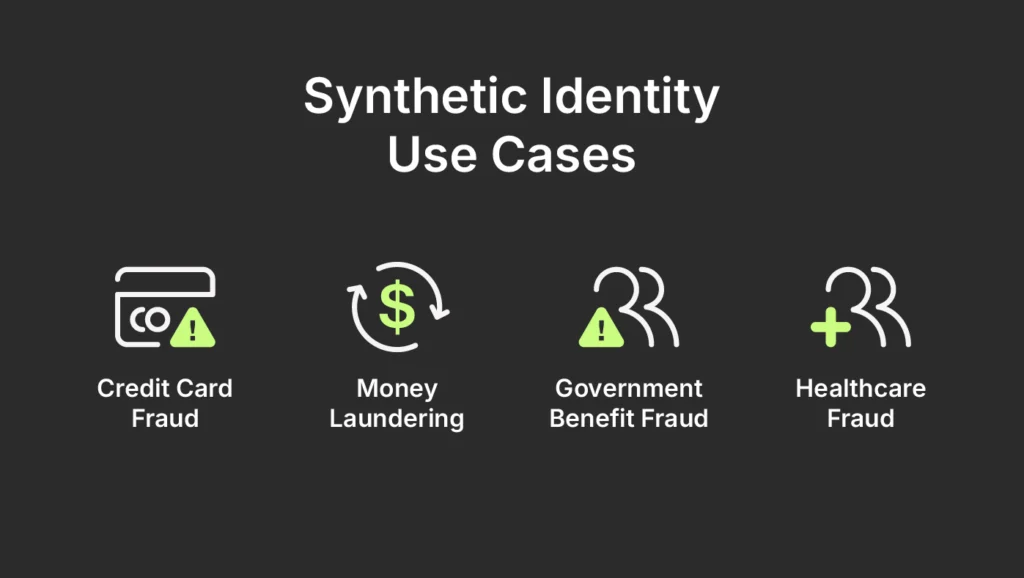
Synthetic identities can serve many criminal purposes and types of fraud. Once established, they become powerful tools for fraudsters to exploit financial systems and beyond.
Credit Card Fraud
One of the most widespread uses of synthetic identities is to apply for credit cards or personal bank loans. Fraudsters often take care of these accounts responsibly by making small purchases first and paying them off to establish credibility.
But, once trust is built, they «bust out», maxing out credit cards or defaulting on loans before disappearing. Because the identity doesn’t belong to a real person, there is no one to pursue for repayment, leaving financial institutions with unrecoverable losses.
Money Laundering
Synthetic identities are also a convenient tool for laundering illicit funds. Fraudsters open multiple accounts under different synthetic profiles, moving money back and forth to obscure its origins. By layering transactions through accounts that appear legitimate on paper, criminals can integrate illegal profits into the financial system without attracting suspicion, making it harder for regulators and investigators to trace.
Government Benefit Fraud
Government programs, such as unemployment benefits, social security, or stimulus relief funds, are common targets for synthetic identity schemes. By using fabricated identities, fraudsters can file multiple fraudulent claims, siphoning money intended for vulnerable populations. The large scale and high volume of such programs make them especially vulnerable, often resulting in billions of dollars in taxpayer losses.
Healthcare Fraud
In the healthcare sector, synthetic identities may be used to obtain medical services, expensive treatments, or prescription drugs. This can range from fraudsters seeking free care to criminal groups acquiring controlled substances for resale. Beyond financial costs, synthetic healthcare fraud risks create corrupted medical records tied to non-existent patients, which can cause confusion or even harm when linked to real individuals.
Why Synthetic Identities Are So Difficult to Detect
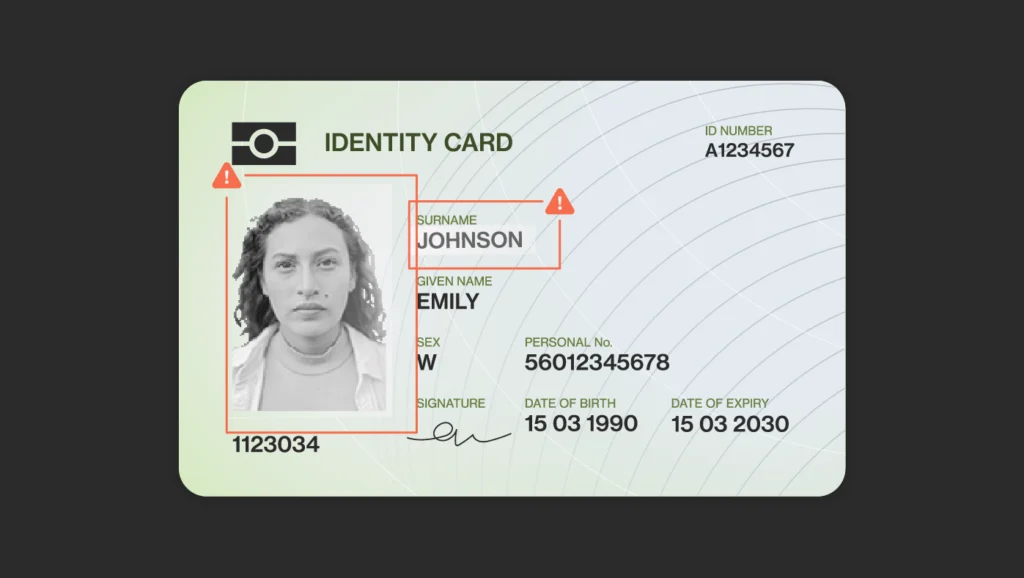
Synthetic identity fraud is difficult to detect because the customer may look real enough to pass basic checks, but not real enough to exist as a legitimate person.
The US Federal Reserve describes synthetic identity fraud as the use of real and/or fictitious information to create a fake identity for fraud, often making it harder for existing systems to detect.
Let’s start by clarifying the difference between a traditional and a synthetic identity fraud:
- Traditional identity theft usually involves impersonating one real individual.
- Synthetic identity fraud involves creating a new identity by combining real and fictional information, such as a real Social Security Number with a fake name, date of birth, address, phone number, or email.
This difference matters. When a real person’s identity is stolen, they may notice suspicious activity, dispute an account, freeze their credit, or report fraud. With synthetic identity fraud, there may be no immediate victim raising the alarm because the fabricated identity does not fully belong to one real person.
EXAMPLE: A fraudster uses a real child’s Social Security Number (SNN), a fake adult name, a rented address, and a newly created phone number. At first, the application may look “thin” rather than suspicious. The fraudster opens a low-risk account, behaves normally, builds history, applies for higher limits, and eventually disappears after maxing out credit or moving funds.
That is what makes synthetic fraud so dangerous, as it’s not always a quick attack. It can be a slow build.
Synthetic identities can pass early checks and become risky later. The fraudster is not only trying to pass onboarding but to create a durable identity that can survive multiple checks across banks, fintechs, lenders, telecoms, marketplaces, and digital platforms.
«Synthetic identity theft is one of the more troubling forms of identity theft and has been a focus of some of our recent investigations. It is a unique form of fraud that combines SSNs of real people with fraudulent information, such as false names and dates of birth, to create new identities.» – Jeffrey Brown, Deputy Assistant Inspector General, Office of the US Inspector General.
Where Traditional Identity Verification Falls Short
Every verification method is useful in itself. Yet, relying on just one method as if it can answer every fraud question is a grave mistake.
Here is what traditional verification methods can and cannot do:
- A document check can confirm whether an ID document appears genuine, but it may not prove that the entire identity history is legitimate.
- A database check can confirm that certain attributes match records, but it may miss a newly assembled identity with just enough real information to pass.
- A credit bureau match can be helpful, but synthetic identities are often designed to slowly build credit history over time.
- A selfie or biometric check (liveness detection) can confirm that a person is present, but it does not automatically prove that the identity behind that face is legitimate.
And now, let’s compare common verification layers:
| Verification Layer | What it helps answer | Where it can fall short |
|---|---|---|
| Identity document check | Is the document genuine and valid? | A real document can still be misused, manipulated, or paired with synthetic data. |
| Database or registry check | Do identity attributes match trusted records? | Matching data does not always prove that the whole identity is real or controlled by the applicant. |
| Biometric liveness detection | Is a real person present during verification? | It does not prove the person is tied to a legitimate identity unless combined with other checks. |
| Device & network intelligence | Does the session look suspicious? | Fraudsters can rotate devices, proxies, and technical fingerprints. |
| Behavioral signals | Does the user behave like a genuine customer? | Behavior alone can be misleading without identity and risk context. |
| Ongoing monitoring | Does the customer remain consistent over time? | It requires connected data, tuning, and regular review. |
This is why, if you want to fight synthetic identity fraud, the layered verification method should be prioritized.
And, at the same time, you need to make sure the onboarding process isn’t overly complicated. Because your goal is to apply the right amount of friction when the risk signals suggest something is wrong.
«Is synthetic identity fraud a victimless crime? After all, the ‘person’ whose identity is used to commit the fraud isn’t a person at all… But just because this kind of identity fraud doesn’t steal from a named victim, it doesn’t mean there aren’t victims. In fact, they come from all over… It’s important that organizations understand that synthetic identity fraud is not an emerging threat – it’s a clear and present one.» – Michael Timoney, Vice President of Secure Payments, Federal Reserve Bank of Boston.
Modern Detection Signals That Matter
Modern synthetic identity detection works best when it connects identity evidence, user behavior, device intelligence, and lifecycle monitoring, because each signal answers a different question.
Identity consistency signals help determine whether the applicant’s data fits together. Does the name match the date of birth? Does the address history make sense? Is the phone number newly issued? Is the email recently created? Has the same document, device, or biometric pattern appeared across multiple identities?
Authoritative database checks help validate whether core attributes are connected to a real person. NIST’s Digital Identity Guidelines describe identity proofing as a process that supports the real-world existence of a claimed identity and confirms that the applicant is associated with that identity. For fraud teams, that distinction is essential, because the identity must exist, and the person presenting it must be connected to it.
Document authenticity checks help detect forged, altered, expired, or suspicious documents. This may include checking document format, security features, data consistency, expiration date, machine-readable zones, and, where available, chip-based verification.
Biometric and liveness checks help confirm that the applicant is physically present and not submitting a stolen photo, mask, screen replay, or manipulated media. This is becoming more important as generative AI changes the attack surface.
Device and network intelligence can reveal patterns that are invisible in identity data alone. Multiple applications from the same device, unusual IP behavior, emulator use, VPN patterns, rapid session switching, or repeated failed attempts can indicate organized fraud rather than a normal customer journey.
Behavioral signals show whether the user behaves like a real customer. For example, a synthetic profile may complete onboarding unusually quickly, paste data into every field, avoid normal browsing behavior, or submit repeated applications with slight changes to personal details.
Ongoing monitoring matters because many synthetic identities look low risk on day one. A profile may pass digital onboarding, behave normally for weeks or months, and become suspicious only when activity changes, limits increase, or linked accounts emerge.
6 Steps to Building a Modern Fraud Prevention Strategy
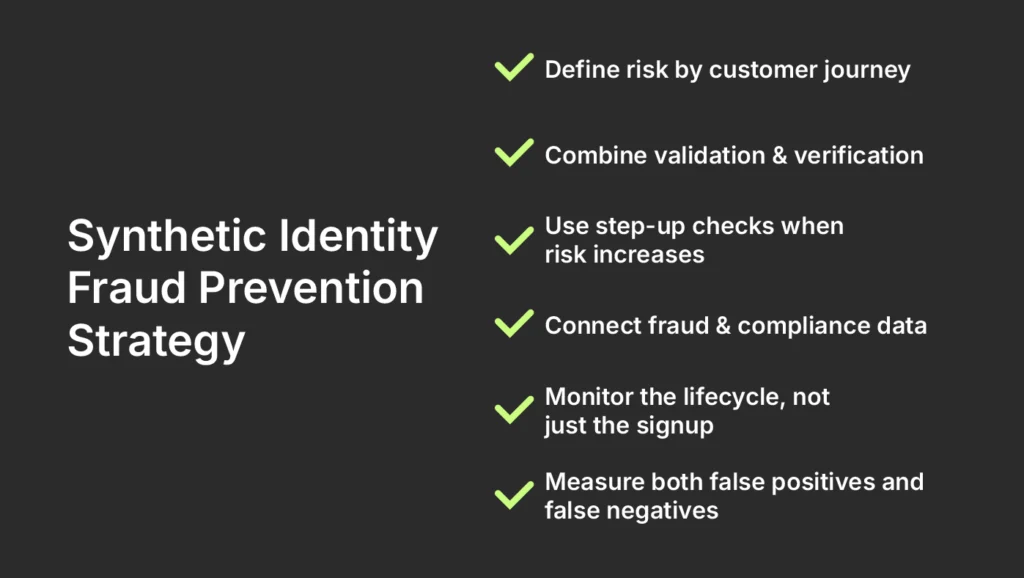
A strong synthetic identity fraud prevention strategy starts before onboarding and continues after approval.
STEP 1. Define risk by customer journey
A low-value account, a high-limit credit product, a crypto withdrawal, and a business payout should not all require the same controls. Risk-based onboarding allows businesses to keep low-risk users moving while applying stronger checks where exposure is higher.
STEP 2. Combine validation and verification
Validation asks whether the data is real and consistent. Meanwhile, verification asks whether the applicant is genuinely connected to that identity. FinCEN’s analysis emphasizes that identity-related exploitation can affect account opening, account access, and transaction processing, which is why identity controls need to cover more than one moment in the customer journey.
STEP 3. Use step-up checks when risk increases
A customer may begin with a lighter identity check. If they request higher limits, add a new payment method, change account details, access higher-risk features, or trigger unusual behavior, the business can ask for stronger verification instead of applying maximum friction upfront.
STEP 4. Connect fraud and compliance data
Synthetic identities often cross product lines and departments. That’s why fraud teams may see device patterns, compliance teams may see suspicious transactions, and customer support may see account recovery abuse. All these signals become more useful when they are connected.
STEP 5. Monitor the lifecycle, not just the signup
Account opening is only the first test. Fraudsters often behave carefully at first, then increase activity once trust has been established. Ongoing monitoring can help detect unusual velocity, linked identities, sudden limit usage, suspicious counterparties, or activity that does not match the customer’s expected profile.
STEP 6. Measure both false positives and false negatives
Blocking too many legitimate users hurts growth. Letting synthetic identities through creates fraud losses, compliance exposure, and operational cleanup. A good strategy should minimize the number of false positives and improve detection without treating every customer like a suspect.
Emerging Trends That Shape Synthetic Identity Fraud
Synthetic identity fraud is changing quickly because the tools available to fraudsters are changing quickly too.
The biggest shift is Artificial Intelligence (AI). In 2024, FinCEN issued an alert warning financial institutions about fraud schemes involving deepfake media created with generative AI, including schemes designed to bypass identity verification and authentication controls.
Artificial Intelligence also lowers the cost of creating convincing personas. Fraudsters can generate realistic profile photos, synthetic documents, fake business websites, social media histories, emails, and scripts for account-opening interactions.
Deepfakes and injection attacks are another concern. A fraudster may not simply upload a fake photo, but try to manipulate a live verification session with synthetic video, altered documents, or injected media. That makes such tools as liveness detection, document integrity checks, and session-level risk signals even more important.
Fraud networks are also becoming more patient. Instead of attacking once, they may create many synthetic identities, test controls across platforms, learn which checks are the weakest, and reuse successful patterns. This makes cross-session and cross-account intelligence increasingly valuable.
Regulatory expectations are moving toward risk-based, evidence-based identity controls. Thus, FATF’s Digital Identity Guidance explains that digital ID systems can support Customer Due Diligence (CDD) and help regulated entities apply a risk-based approach to identifying and verifying customers.
This does not mean every business needs to have the strongest possible controls for every user. It means businesses need to understand the assurance level of their identity process and match it to the risk they carry.
Key Takeaways
Synthetic identity fraud is difficult to spot because fraudsters are not always pretending to be one real person. They are often building a new person from fragments of real and fake data.
Traditional verification methods still matter, but they are not enough on their own. Document checks, database checks, biometrics, liveness detection, device intelligence, behavioral analytics, and monitoring all answer different questions.
The strongest strategies for fighting synthetic identity fraud combine different methods.
Synthetic identity detection should not stop at onboarding. Many synthetic profiles are designed to look normal at first, build trust, and become risky later.
And the worst thing is that AI will make synthetic identities cheaper, more realistic, and easier to scale in the future. Therefore, fraud and compliance teams should prepare for more convincing documents, deepfake-enabled attacks, and more coordinated testing of onboarding controls.
For compliance professionals evaluating an identity verification strategy, the most practical questions are:
- Does our process validate that the identity exists?
- Does it verify that the applicant is connected to that identity?
- Can it detect suspicious devices, sessions, and behavioral patterns?
- Can we step up verification when risk increases?
- Do we monitor customers after onboarding, or do we only check them once?
To effectively prevent synthetic identity fraud in the future, you will not come up with one perfect check, but rather manage the threats by employing layered signals, making risk-based decisions, and applying identity controls that keep learning after the customer is approved.
FAQ